
Why You Can’t Reason With a Narcissist: The Neurobiology Behind the Two-Track Mind™
Why You Can’t Reason With a Narcissist: The Neurobiology Behind the Two-Track Mind™ Why narcissists deny reality, reject accountability, and seem unable to understand.

“The greatest mistake people make is believing they’re arguing with a narcissist’s conscious mind. More often, they’re arguing with a survival system that learned long ago that admitting fault felt more dangerous than losing the relationship.”
Have you ever walked away from a conversation wondering how someone could deny what you both just witnessed?
You have the text messages. The emails. The screenshots. The witnesses.
Yet somehow, the conversation ends with you defending your own reality while they remain completely convinced that they are right.
It’s one of the most psychologically disorienting experiences a person can have.
People often ask:
“Are they intentionally lying, or do they actually believe what they’re saying?”
The answer is more complex than either choice.
To understand why reasoning often fails, we have to look beyond behavior and examine what developmental psychology and neuroscience tell us about how some individuals with Narcissistic Personality Disorder (NPD) process emotional threats. From there, I’ll introduce what I call The Two-Track Mind™—a framework that helps explain why logical conversations often go nowhere.
The Brain Doesn’t Begin as Narcissistic
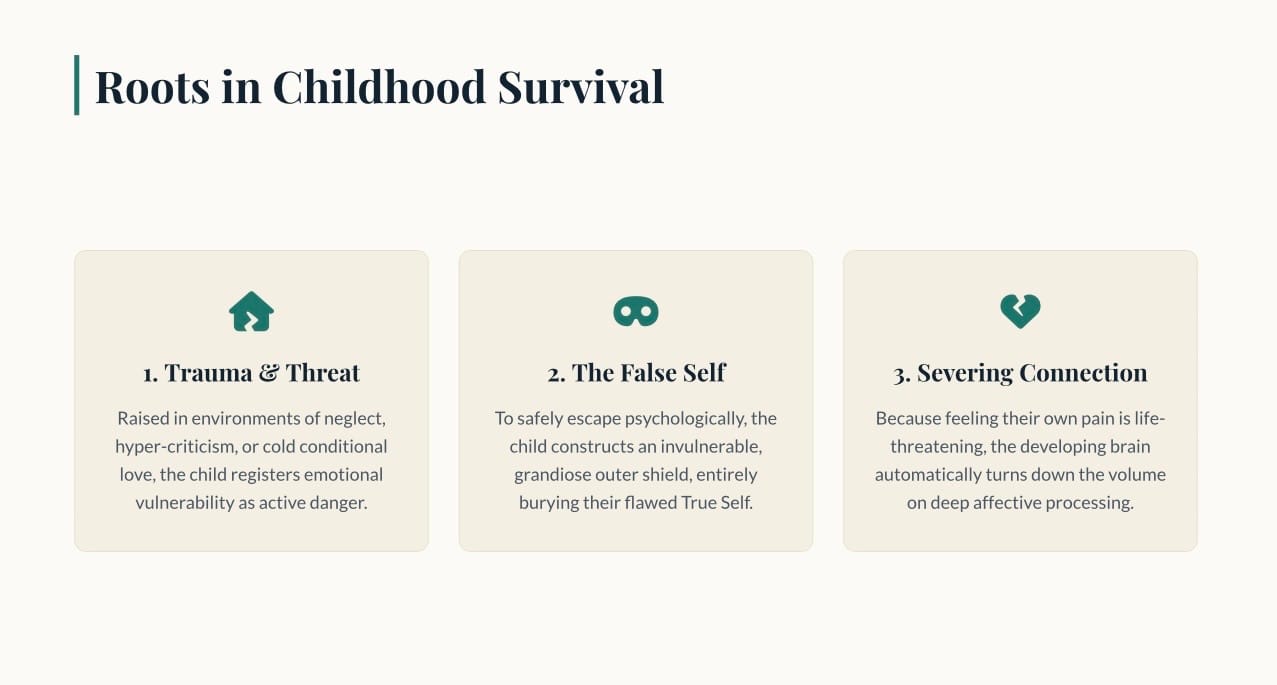
No child is born a narcissist.
Research suggests that narcissistic personality traits develop through a combination of genetic vulnerability, temperament, and early environmental experiences. Children who grow up with chronic emotional neglect, unpredictable caregiving, severe criticism, excessive praise tied only to achievement, or conditional love may learn that their authentic self is unsafe.
Instead of developing a secure identity, they develop a protective identity.
The vulnerable self becomes hidden.
The idealized self becomes the version presented to the world.
Over many years, these coping strategies become deeply ingrained patterns of thinking, feeling, and relating to others.
What Neuroscience Has Found
Brain imaging studies suggest that some individuals diagnosed with NPD show differences in areas involved in emotional processing and empathy.
One area receiving considerable attention is the anterior insula, a region involved in affective empathy, the ability to emotionally resonate with another person’s experience.
Some studies have found reduced gray matter volume or altered functioning in this region, which may contribute to difficulties emotionally connecting with another person’s distress.
This does not mean narcissists cannot recognize emotions.
Quite the opposite.
Many are exceptionally skilled at reading facial expressions, body language, social dynamics, and emotional vulnerabilities.
This reflects the difference between two forms of empathy.
Cognitive Empathy
Understanding what another person feels.
This ability is often relatively intact.
It helps explain charisma, charm, persuasion, and, at times, manipulation.
Emotional (Affective) Empathy
Feeling another person’s emotional state.
Research suggests this capacity may be significantly impaired in some individuals with NPD, making emotional connection much more limited.
Understanding someone’s pain is not the same as emotionally experiencing it.
That distinction changes everything.
Introducing The Two-Track Mind™
You’ve just read the science. Members unlock the framework.
Continue reading to discover:
- The complete Two-Track Mind™ model
- Why logic fails with narcissistic personalities
- How to stop getting trapped in circular arguments
- Practical strategies to protect your peace
Included with your membership to The Emotional Decoding Framework™ Library.