
The Architecture of the "Aha" Moment: Why Your Best Decisions Happen When You’re Not Thinking.

We’ve been conditioned to believe that high-stakes leadership requires constant, grinding analysis. We sit in boardrooms and stare at spreadsheets, trying to "brute force" solutions to complex problems.
But the science of Industrial-Organizational (I-O) Psychology suggests we might be doing it backward. If you want to make smarter decisions, you have to master the Incubation Strategy.
The "Apartment Experiment" Paradox
In a landmark study on decision-making, researchers gave participants complex information about four different apartment options, each with a mix of pros and cons.
• The Rational Trap: Most people believe that the more complex a choice is, the smarter it is to make that decision rationally rather than intuitively.
• The Reality: In this experiment, the group that was given the facts and then distracted for a time before giving their decision actually made the smartest choice.
Why Logic Fails at Scale
Our conscious mind is a "serial processor." While it is vital for critical thinking, it can be "cluttered" by too many facts when facing complex tasks. Facing a difficult decision involving a lot of facts, we are often wiser to gather the information and then say, "Give me some time not to think about this".
When you "stop thinking," you aren't stopping the work. You are letting your unconscious mental machinery take over.
Analysis Frozen into Habit
This isn't guessing. Intuition is "analysis frozen into habit" it is implicit, unconscious knowledge recorded in our brains that we can't always fully explain. For anything in which you have developed deep and special knowledge based on experience, your brain can size up a situation and react in an eyeblink.
The 4-Stage Strategy: How to Incubate
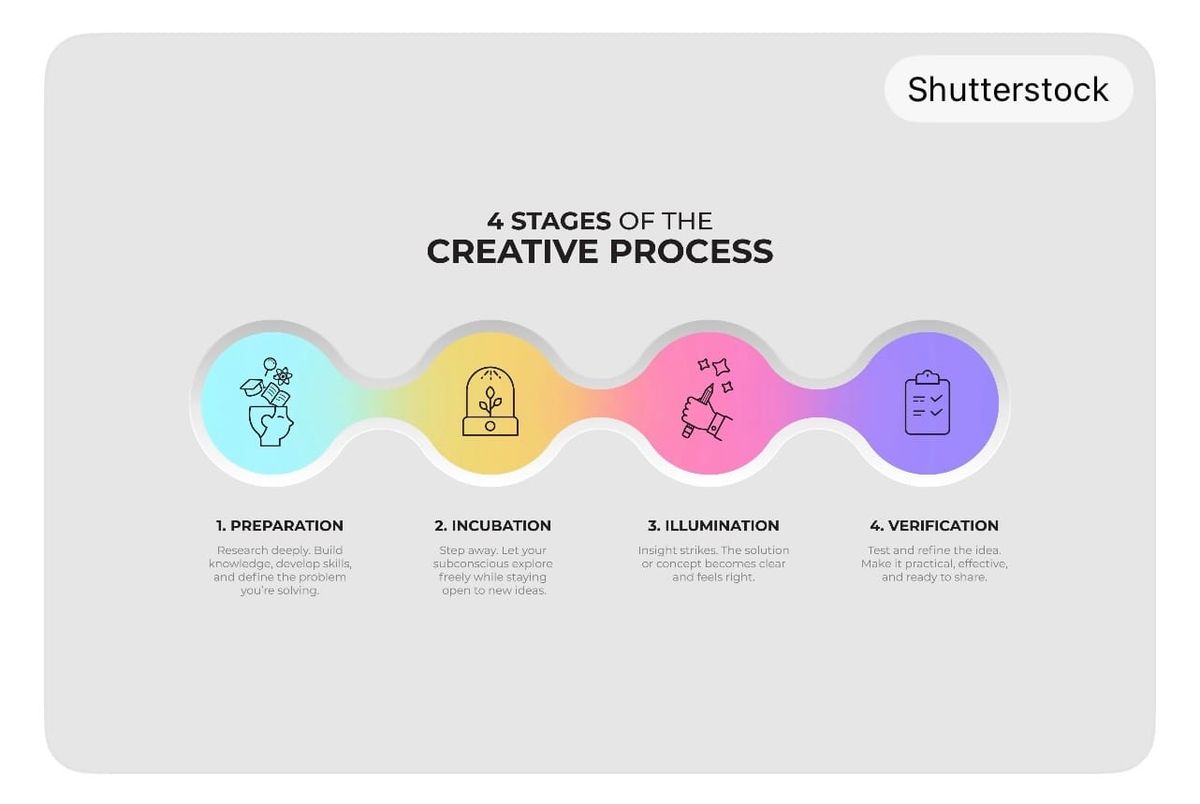
To use the process shown in our featured image, you must treat "not thinking" as a deliberate executive function:
1. Preparation: Saturate your mind. Research deeply, build your knowledge, and define the specific problem you are solving.
2. Incubation: Step away. Let your subconscious explore the data freely while you attend to unrelated things.
3. Illumination: This is the "Aha!" moment. The solution or concept becomes clear and, importantly, it feels right.
4. Verification: Our "two-track mind" makes sweet harmony as smart, critical thinking listens to the creative whispers of the unseen mind and then tests those conclusions for the future.
The Bottom Line: Smart thinkers don't just work harder; they know when to let their vast, unseen mind take the lead.
What was the last major breakthrough you had while you were doing something completely unrelated to work? Describe the 'detour' that led to the discovery.